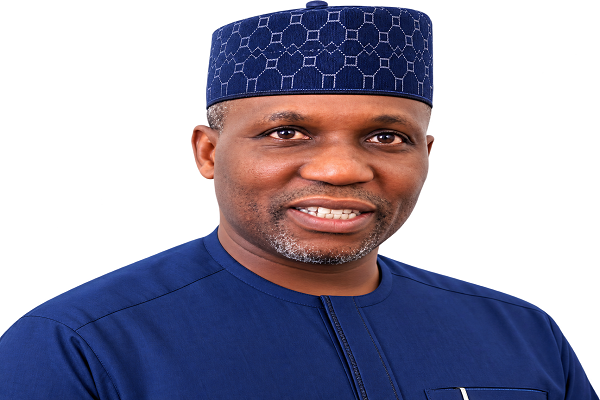
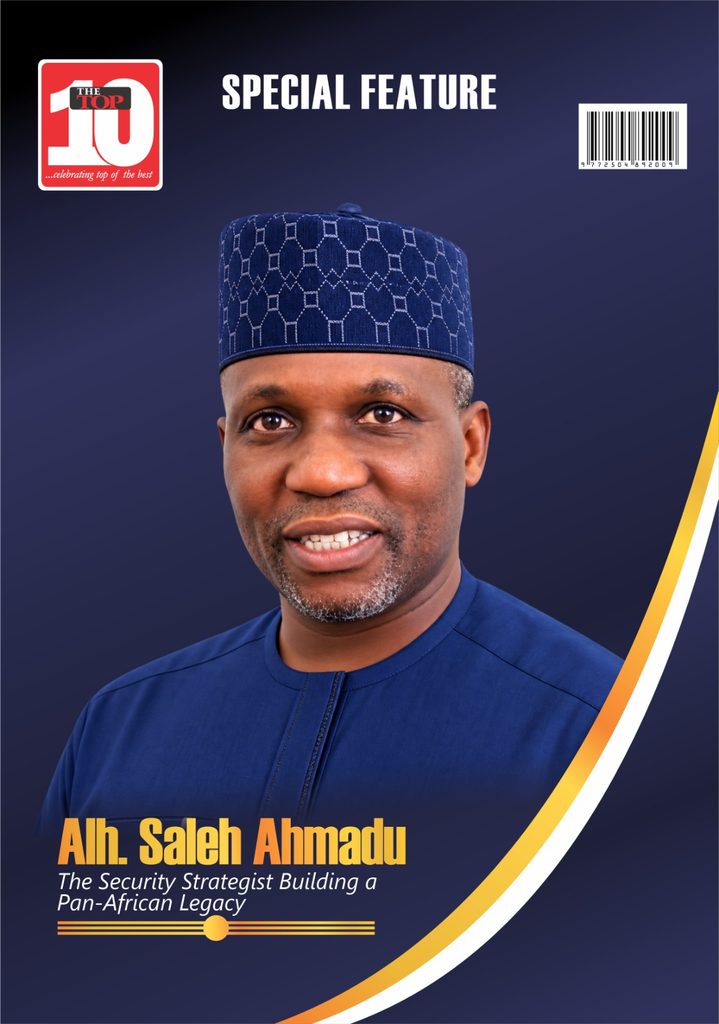
From four decades in security and intelligence to a landmark $3.1 billion AfCFTA Customs Modernisation Project, the story of Alhaji Saleh Ahmadu is one of enterprise, strategic vision, national service and philanthropy.
In Nigeria’s evolving security and business landscape, few private-sector figures have combined security expertise, entrepreneurship, national service and philanthropy as seamlessly as Alhaji Saleh Ahmadu, OON, Executive Chairman of Bergmans Security Consultants and Supplies Limited.
With about four decades of experience spanning security consultancy, systems acquisition, aviation, national security, cybersecurity and intelligence, Ahmadu has built a reputation around one defining quality: the ability to identify complex challenges and develop strategic solutions capable of delivering results.
Today, that journey has taken him far beyond the traditional boundaries of private security. Through Bergmans and its associated businesses, he has become involved in projects with implications for Nigeria’s trade infrastructure and, increasingly, the wider African economy.
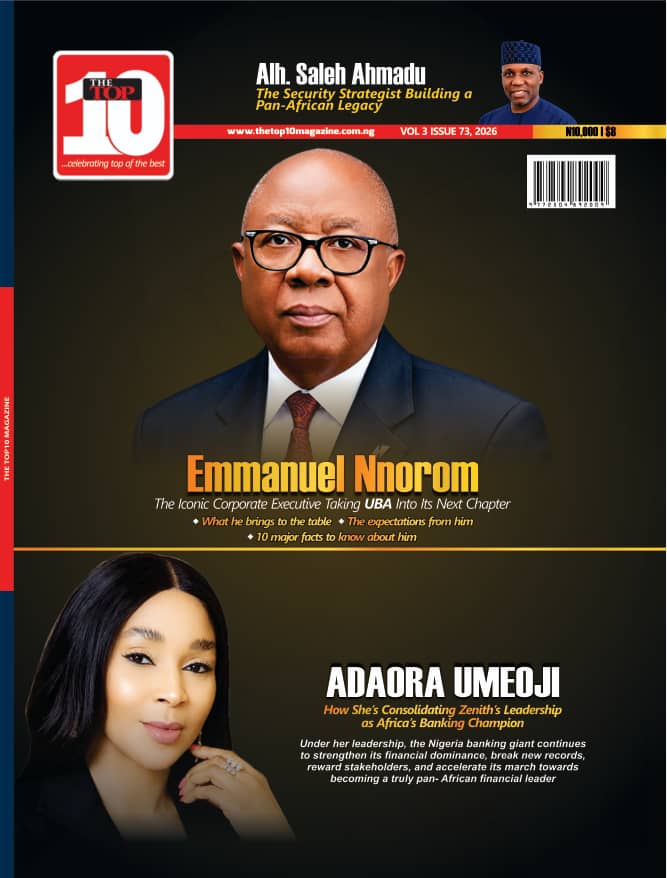
His most significant recent milestone is the landmark 20-year concession agreement with the Secretariat of the African Continental Free Trade Area (AfCFTA) for the implementation of the AfCFTA Customs Modernisation Project. The agreement, valued at $3.1 billion, places Ahmadu and Bergmans at the centre of an ambitious attempt to modernise customs operations and facilitate the movement of goods across African borders.
A career built around security and strategy
Ahmadu’s professional journey has been shaped by an unusual depth of experience in security-related fields.
According to background check revelations he has spent about four decades working as a security consultant and systems acquisition specialist, with exposure to aviation, national security, cybersecurity and intelligence. He has also worked with national and international security organisations and coordinated transnational security partnerships.
This experience has given him an extensive network of partners across different jurisdictions and security ecosystems. His work has been described as extending beyond conventional security services into threat assessment, risk analysis, integrated security systems, procurement and training.
It is this combination of technical understanding, strategic thinking and entrepreneurial capacity that has distinguished Ahmadu’s approach to business.
Rather than treating security as an isolated function, his career has increasingly reflected an understanding of security as part of a broader system involving technology, infrastructure, intelligence, trade, risk management and economic development.
Building Bergmans into a strategic enterprise
At the centre of Ahmadu’s business story is Bergmans Security Consultants and Supplies Limited.
The company describes itself as a provider of technology-driven solutions and services, with an emphasis on innovative and scalable offerings. Its evolution reflects an entrepreneurial approach focused on understanding the needs of clients and adapting solutions to changing market demands.
Under Ahmadu’s leadership, however, Bergmans’ significance has extended beyond its identity as a security company.
The company has become associated with major technology and infrastructure initiatives, particularly in the area of customs modernisation. Its subsidiary, AfriTrade CMP Limited, is to implement the AfCFTA Customs Modernisation Project, while Bergmans is also identified as the parent company of Trade Modernisation Project Limited (TMP), the concessionaire involved in the Nigeria Customs Service modernisation project.
That evolution illustrates perhaps one of the most important features of Ahmadu’s career: his ability to move from traditional security solutions into technology-enabled systems capable of addressing large-scale national and continental challenges.
The $3.1 billion AfCFTA opportunity
For Ahmadu, the landmark AfCFTA agreement represents the biggest expression yet of that vision.
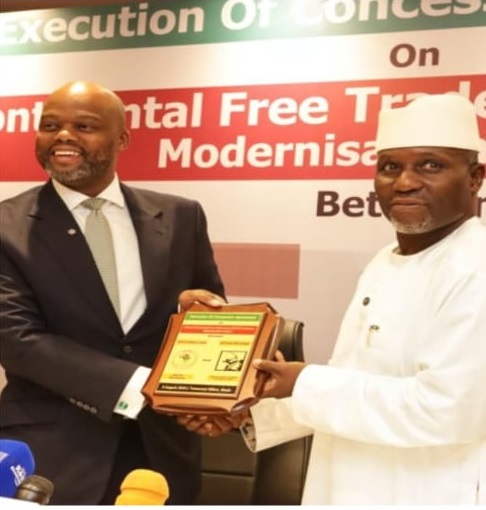
The 20-year concession agreement between Bergmans and the AfCFTA Secretariat is designed to support the implementation of a continent-wide customs modernisation project. The $3.1 billion Public-Private Partnership was signed by AfCFTA Secretary-General Wamkele Mene and Ahmadu and will be implemented through Bergmans’ subsidiary, AfriTrade CMP Limited.
The project envisages the deployment of unified digital customs platforms, electronic cargo-tracking systems, non-intrusive inspection technology and integrated data infrastructure across participating African countries. Its broader objective is to improve customs efficiency and facilitate intra-African trade.
The significance of the agreement goes beyond its financial value.
Africa’s ambition of creating a genuinely integrated market depends heavily on the ability of goods to move efficiently across borders. Customs systems that are slow, fragmented or poorly integrated can create delays, raise costs and undermine the benefits of continental free trade.
The modernisation project therefore will address some of these structural problems by digitalising and simplifying customs procedures, enabling secure electronic exchange of customs information and strengthening coordination among border-management agencies.
It is also expected to support modern transit systems, stronger risk-management mechanisms, data analytics and capacity-building programmes for customs authorities.
In practical terms, the project is intended to make African borders smarter, more connected and more predictable for businesses and traders.
From Nigerian expertise to a continental platform
Perhaps the most remarkable aspect of the AfCFTA project is what it says about the changing profile of Nigerian enterprise.
President Bola Ahmed Tinubu congratulated Ahmadu and Bergmans on the execution of the agreement, describing it as evidence that Nigerian companies can develop and deliver solutions of continental significance. The President also described the agreement as an important milestone for Nigeria and an endorsement of indigenous expertise.
For Ahmadu, therefore, the project represents more than a commercial achievement. It is also an opportunity to demonstrate that Nigerian businesses can participate meaningfully in the development of critical infrastructure beyond the country’s borders.
The project is expected to strengthen customs cooperation, improve cargo visibility, reduce border delays and contribute to the trade-facilitation objectives of AfCFTA.
At the signing of the MoU connected with the project, Ahmadu described the initiative as a Public-Private Partnership through which Bergmans would invest in comprehensive Pan-African digital and physical infrastructure designed to harmonise customs processes, enhance trade corridors and streamline the movement of goods across participating states.
A project rooted in previous experience
The AfCFTA initiative did not emerge in isolation.
Ahmadu’s Trade Modernisation Project Limited has been involved in the Nigeria Customs modernisation project. The project has been described as a private-sector-led Presidential initiative, with Ahmadu pointing to its successes and international recognition.
The earlier experience provided an important platform for the larger continental ambition.
It is reported that Ahmadu committed more than $3 billion in private funding in partnership with Huawei and the Africa Finance Corporation for the customs modernisation effort, while the Nigeria Customs modernisation project was projected to generate more than ₦176 billion for the Federal Government over 20 years.
Whether in security or trade infrastructure, the underlying philosophy appears consistent: combine private capital, technology, strategic partnerships and local expertise to tackle large-scale institutional challenges.
Recognition at the highest national level
Ahmadu’s contributions have not gone unnoticed.
In 2022, he was conferred with the national honour of Officer of the Order of the Niger (OON) by the Federal Government of Nigeria. The honour was conferred on October 11, 2022, alongside other prominent Nigerians and foreigners in recognition of contributions to national development.
The OON represents one of the most significant recognitions of his career because it places his private-sector contributions within the broader context of national service.
His professional achievements have also earned him recognition from prestigious institutions. He is listed as a Grand Fellow of the Chartered Institute of Strategic Management of Nigeria and a Fellow of the Chartered Institute of Management and Leadership, Kentucky, United States.
In 2024, he received honorary doctorate degrees in Science from the Federal University, Lokoja, Kogi State, and in Strategic Management from the IIC University of Technology, Cambodia.
These honours complement his traditional recognitions, including the titles of Madaki Lokoja and Makama of Kakanda Kingdom, which can be linked to his contributions to community development, peace, religious tolerance and social cohesion.
The philanthropist behind the businessman
Away from boardrooms, security contracts and multinational projects is another dimension of Ahmadu’s life that is central to his public
profile: philanthropy.
Through the Saleh Ahmadu Foundation (SAF), he has supported life-impacting initiatives aimed at improving the wellbeing of individuals and communities.
The foundation’s interventions, according to reports, have included economic empowerment for rural communities, employment opportunities and efforts to alleviate poverty.
His philanthropic interests have also extended to education, healthcare and support for widows. President Tinubu, in a birthday message to Ahmadu, specifically acknowledged the sustained humanitarian interventions of the Saleh Ahmadu Foundation in these areas.
This humanitarian dimension helps explain why Ahmadu’s public profile extends beyond the corporate world.
For him, wealth creation and social responsibility appear to occupy complementary spaces. The businesses create economic value and employment, while philanthropy provides direct interventions for communities and vulnerable groups.
Using influence to promote peace and coexistence
Another important component of Ahmadu’s philanthropic and community activities is his support for religious groups and initiatives promoting peaceful coexistence.
The reports credit his support with contributing to ethno-religious peace, tolerance, love and mutual respect.
In a country where religious and communal tensions can easily undermine development, such interventions carry significance beyond the immediate beneficiaries.
His traditional titles, including Madaki Lokoja, have also become part of this broader story of community engagement and social cohesion.
President Tinubu has similarly recognised Ahmadu’s role in promoting religious tolerance, peaceful coexistence, culture and tradition.
A job creator beyond the spotlight
One of the less visible aspects of Ahmadu’s career is employment creation.
Reports note that he has worked in the private sector for more than three decades, providing jobs for hundreds of people.
This is significant because the impact of an entrepreneur is not measured solely by the size of contracts won or the value of assets controlled. It is also measured by the number of people whose livelihoods are connected to the enterprises he builds.
His business interests extend beyond Bergmans, with board positions in organisations including The Business People Limited, Ashawa Consult Nigeria Limited, Sandhall Global Consulting Limited and Furnished Electronics Nigeria Limited.
A convergence of security, technology and trade
The evolution of Ahmadu’s career provides an interesting picture of how the security industry itself is changing.
The security challenges of the modern world are no longer limited to guards, physical barriers or conventional surveillance. They increasingly involve cybersecurity, data, intelligence, risk management, digital infrastructure, supply chains and the secure movement of people and goods.
Ahmadu’s career cuts across many of these areas.
His background in aviation, national security, cybersecurity and intelligence has been complemented by his involvement in large-scale technology and customs modernisation initiatives.
The AfCFTA project takes this evolution to another level by applying technology and security architecture to one of Africa’s most important economic ambitions: making continental trade easier, faster and more efficient.
The road ahead
The biggest test of Ahmadu’s latest achievement will not be the signing ceremony but implementation.
A 20-year continental concession of this scale comes with enormous expectations. The success of the AfCFTA Customs Modernisation Project will ultimately be judged by how effectively it improves border processes, strengthens customs administration, increases transparency, manages trade-related risks and makes legitimate commerce easier across Africa.
It will also test the capacity of Nigerian private enterprise to execute a complex, multinational infrastructure project at scale.
For Ahmadu, that challenge represents a natural progression from the security sector in which he built his reputation.
His career has moved from protecting people, assets and institutions to helping build systems that can protect revenue, improve border security, facilitate legitimate trade and connect African economies.
The making of a national and continental player
The story of Alhaji Saleh Ahmadu is ultimately a story of evolution.
He began his rise through the demanding world of security consultancy, systems acquisition and strategic risk management. Over the years, he expanded into entrepreneurship, built networks across national and international security ecosystems, supported communities through philanthropy and earned recognition at both professional and national levels.
The OON, his professional fellowships, honorary doctorates and traditional titles tell part of the story. But perhaps the clearest evidence of his expanding influence is the scale of the responsibilities now associated with his businesses.
From security and intelligence to customs modernisation; from Nigerian enterprise to Pan-African infrastructure; from corporate boardrooms to rural communities, Ahmadu’s footprint has continued to widen.
And that may well be the most important chapter yet.
The landmark AfCFTA agreement has positioned him at the intersection of security, technology, trade and continental economic integration. If successfully implemented, it could become one of the defining achievements of his career and an important demonstration of what indigenous Nigerian enterprise can contribute to Africa’s development.
For a man whose career has largely been built away from the glare of public office, the journey from security consultant to a key private-sector player in Africa’s trade modernisation agenda is a remarkable one.
Alhaji Saleh Ahmadu is no longer merely securing businesses and institutions. Through the scale of his current projects, he is helping to build the infrastructure for a more connected Africa.